 At the risk of getting hate mail from the rabid fans of this book--I was underwhelmed. A myriad of problems in this book (and I'm not talking about the theology, people have a right to their opinion) but it would be ALMOST palatable if the foreword was removed. Painfully manipulative. If my sister hadn't recommended this book, I would have stopped right there, but I finished it and I'll never read a book I can't respect again, for anyone. Amen!
Friday, August 21, 2009
The Shack by William P. Young
At the risk of getting hate mail from the rabid fans of this book--I was underwhelmed. A myriad of problems in this book (and I'm not talking about the theology, people have a right to their opinion) but it would be ALMOST palatable if the foreword was removed. Painfully manipulative. If my sister hadn't recommended this book, I would have stopped right there, but I finished it and I'll never read a book I can't respect again, for anyone. Amen!


Wittgenstein's Mistress by David Markson
 Synopsis: A female artist writes about her life as the last person on earth.
Reasons why I stopped reading this book halfway through (and then skipped to the end.)
1.Interesting ideas, which is essential for me as a reader, but the language style was tedious. Even an intentional tedium is still tedious.
2. Male author speaking as a female. This often works, however the way the narrator speaks about her menstruation sounded like a man trying to sound like a woman and that "willing suspension of disbelief" got suspended right there.
3. Also halfway, I realized the narrator sounded exactly like me and I spend enough time in my own head; I want some relief.
4. It would have been nice if some resolution or growth occurred somewhere--I guess I'm a traditionalist after all.
Tuesday, May 19, 2009
Proust was a Neuroscientist

Actually about Proust as well as Virginia Woolf, Walt Whitman, George Eliot, Paul Cezanne, Igor Stravinsky, Gertrude Stein and Auguste Escoffier and how all of these artists of word, paint, and music anticipated the discoveries of neuroscience. Engaging, witty, clearly written, and every page a wealth of new fascinating tidbits of knowledge; this book would be the ideal text for any classroom of humanists trying to grasp the appeal of science and science students overlooking the contributions of the arts to the world of science. Ultimately, an appeal for a closer association and understanding between art and science.
Saturday, May 2, 2009
On Truth by Harry Frankfurt
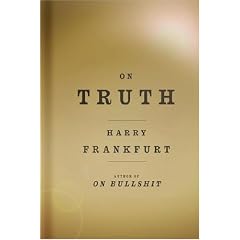
Pros:
- Shiny gold cover.
- It's small. 4 1/8 inches wide by 6 1/4 inches tall.
- It's short. A mere 101 pages with an average column width of 2 1/2 inches.
- The first two sentences on page 49 contain: two i.e.(s) , the word truth in quotes, another word in italics, three dashes and then a quoted word again this time within a parentheses.
- No pictures.
- I'm a cretin.
Wednesday, April 29, 2009
An Artist of the Floating World by Kazuo Ishiguro
The inherent dangers of first person. 
A little under a quarter of the way into the novel, there is a scene recalled by the first person narrator that is both poignant and horrific. Out of sight of the boy and his mother, the narrator's father alone in his study is burning the boy's paintings.
"There's a smell of burning around the house," I remarked.
"Burning?" My mother was silent for a while, then she said: "No, I don't think so. It must be your imagination, Masuji."
"I smelt burning," I said. "There, I just caught it again. Is Father still in the reception room?"
"Yes, He's working on something."
"Whatever he's doing in there," I said, "it doesn't bother me in the least."
From that scene, the force of the novel springs, but as a narrator relating his own story the deliberate inclusion of that scene comes across as an obvious ploy to elicit sympathy, a psychological tool or weapon wielded by the narrator to justify his every action and every mistake.
This in itself is not a flaw.
However, unwilling or unable to confront his pain, his artist's soul fatally wounded, the main character suppresses his feelings from that moment on. The adult narrator that relates the rest of the novel has removed himself from his own life and since this is told in the first person, the reader also ends up stuck in this frozen sterile limbo. The narrator is indeed drifting in a floating world finding pride only in pleasing the father replacement in his life, the patriarchal imperialistic regime. Nothing else matters to him and so recounting the story from first person it is difficult to convey anything beyond his narrow and damaged vision.
As readers, we are never allowed to witness any of the art he created, not the works destroyed and not the problematic political art he hangs his reputation on later. If he learns, grows, changes or even fails to change, he can barely express it. Ultimately and regretfully, I could not care about his journey and thus for me the novel was a failure.
A little under a quarter of the way into the novel, there is a scene recalled by the first person narrator that is both poignant and horrific. Out of sight of the boy and his mother, the narrator's father alone in his study is burning the boy's paintings.
"There's a smell of burning around the house," I remarked.
"Burning?" My mother was silent for a while, then she said: "No, I don't think so. It must be your imagination, Masuji."
"I smelt burning," I said. "There, I just caught it again. Is Father still in the reception room?"
"Yes, He's working on something."
"Whatever he's doing in there," I said, "it doesn't bother me in the least."
From that scene, the force of the novel springs, but as a narrator relating his own story the deliberate inclusion of that scene comes across as an obvious ploy to elicit sympathy, a psychological tool or weapon wielded by the narrator to justify his every action and every mistake.
This in itself is not a flaw.
However, unwilling or unable to confront his pain, his artist's soul fatally wounded, the main character suppresses his feelings from that moment on. The adult narrator that relates the rest of the novel has removed himself from his own life and since this is told in the first person, the reader also ends up stuck in this frozen sterile limbo. The narrator is indeed drifting in a floating world finding pride only in pleasing the father replacement in his life, the patriarchal imperialistic regime. Nothing else matters to him and so recounting the story from first person it is difficult to convey anything beyond his narrow and damaged vision.
As readers, we are never allowed to witness any of the art he created, not the works destroyed and not the problematic political art he hangs his reputation on later. If he learns, grows, changes or even fails to change, he can barely express it. Ultimately and regretfully, I could not care about his journey and thus for me the novel was a failure.
Friday, September 26, 2008
The Inhabited World by David Long
 (The hardbound edition.)
[Stopped around page 24. Not the author's fault.]
For many years now, my sister Sue, who resides and reads in Walla Walla, Washington, regularly indulges in a mystery book. Not necessarily in the mystery genre, although it could be, but when she visits her local library she makes a point of grabbing a book that has no book jacket. Even better, a book without any inside cover notes, although those are increasingly rare as librarians weed them out. She does this so that the book, for better or worse, will be a complete surprise. Whether she likes it or not will be up to her and her alone.
Alas, Reading is no longer a solitary endeavor.

Consider these two editions of "The Inhabited World".
Do not read the back of this book.
The back of the hardbound edition has three short reviews by three different authors. These comments center on the quality of Long's writing. I'm assuming they mean lines such as this one found on page 5 of paperback version:
"He's steeped in aftermath, as changed as steam is from water, as water from ice. " Lovely.
Unfortunately, the paperback edition has the ubiquitous promotion plastered on front and back. The front comment by the Los Angeles times is inoffensive but the back comment by the New York Times Book Review is a Spoiler Alert! It certainly spoiled it for me. I don't mind their banal comment that "This is a terrific novel", but I would like to discover the ending on my own. I want to consume a book, I don't need it spoonfed.
So if you want to read this book, get the hardbound or do not read the press on the paperback, but now that I've mentioned it will be hard not to look. Sorry.
Tuesday, September 16, 2008
All the Names by José Saramago

When was the paragraph invented? I became obsessed with this question recently after trying to read All the Names by José Saramago (translated from Portugese by Margaret Jull Costa), a book of large unbroken columns of text, where rapidly the random arbitrary nature of language resurfaces and the act of reading reverts to its unnatural and alien beginnings.
My first thought--it was Saramago's stylistic decision, a reflection of the setting of miles of unbroken files, the twin towers of life and death records of the "Central Registry" that surrounds the main character Senhor José. My second thought--I shall attempt this feat; this book is worth it; this book won the Nobel Prize for Literature. Even with that shining destination-I failed.
There are a few paragraph breaks of course, but by then I was clinging to each stopping point as a mountain climber grips a tiny ledge on a smooth rock face. Once I glanced ahead in the book and realized the entire text was the same absolute column of text I realized that at some point I would fall off that mountain. I guess I'm just not much of a climber, I mean reader; I didn't even reach base camp.
Sadly, I will never know if Saramago's promise is fulfilled; that piercing sweet uncanny moment when media, those literal towers of words becomes metaphor. With metaphor we no longer need to cling to the mountain. We are given wings, liberated from gravity.
Why did I pick up this book? The cover art, a sepia photograph of a man surrounded by tall dark buildings and floating slightly off the ground. The figure of the man is facing the light at the end of the cavernous street; I never got that far.
Post script: Before returning this book I discovered a book mark left in the book by a former library patron. The bookmark depicts a tower of books and the top book is titled "Keep Reading". The bookmark was left in the book about 3/4s of the way through.
Subscribe to:
Posts (Atom)


