Friday, September 26, 2008

The Inhabited World by David Long

(The hardbound edition.)

[Stopped around page 24. Not the author's fault.]


For many years now, my sister Sue, who resides and reads in Walla Walla, Washington, regularly indulges in a mystery book. Not necessarily in the mystery genre, although it could be, but when she visits her local library she makes a point of grabbing a book that has no book jacket. Even better, a book without any inside cover notes, although those are increasingly rare as librarians weed them out. She does this so that the book, for better or worse, will be a complete surprise. Whether she likes it or not will be up to her and her alone.
Alas, Reading is no longer a solitary endeavor.
Consider these two editions of "The Inhabited World".


This is an image of the paperback edition. >>>>>>
Do not read the back of this book.

The back of the hardbound edition has three short reviews by three different authors. These comments center on the quality of Long's writing. I'm assuming they mean lines such as this one found on page 5 of paperback version:

"He's steeped in aftermath, as changed as steam is from water, as water from ice. " Lovely.

Unfortunately, the paperback edition has the ubiquitous promotion plastered on front and back. The front comment by the Los Angeles times is inoffensive but the back comment by the New York Times Book Review is a Spoiler Alert! It certainly spoiled it for me. I don't mind their banal comment that "This is a terrific novel", but I would like to discover the ending on my own. I want to consume a book, I don't need it spoonfed.
So if you want to read this book, get the hardbound or do not read the press on the paperback, but now that I've mentioned it will be hard not to look. Sorry.

Tuesday, September 16, 2008

All the Names by José Saramago


When was the paragraph invented? I became obsessed with this question recently after trying to read All the Names by José Saramago (translated from Portugese by Margaret Jull Costa), a book of large unbroken columns of text, where rapidly the random arbitrary nature of language resurfaces and the act of reading reverts to its unnatural and alien beginnings.

My first thought--it was Saramago's stylistic decision, a reflection of the setting of miles of unbroken files, the twin towers of life and death records of the "Central Registry" that surrounds the main character Senhor José. My second thought--I shall attempt this feat; this book is worth it; this book won the Nobel Prize for Literature. Even with that shining destination-I failed.

There are a few paragraph breaks of course, but by then I was clinging to each stopping point as a mountain climber grips a tiny ledge on a smooth rock face. Once I glanced ahead in the book and realized the entire text was the same absolute column of text I realized that at some point I would fall off that mountain. I guess I'm just not much of a climber, I mean reader; I didn't even reach base camp.

Sadly, I will never know if Saramago's promise is fulfilled; that piercing sweet uncanny moment when media, those literal towers of words becomes metaphor. With metaphor we no longer need to cling to the mountain. We are given wings, liberated from gravity.


Why did I pick up this book? The cover art, a sepia photograph of a man surrounded by tall dark buildings and floating slightly off the ground. The figure of the man is facing the light at the end of the cavernous street; I never got that far.

Post script: Before returning this book I discovered a book mark left in the book by a former library patron. The bookmark depicts a tower of books and the top book is titled "Keep Reading". The bookmark was left in the book about 3/4s of the way through.

Wednesday, August 27, 2008

No Country for Old Men by Cormac McCarthy


I couldn't finish it and I'm not happy about it.

I can't state exactly where I gave up since I kept trying and frankly I've seen the movie and it's such a perfect replica of the book that the two have grown together in my mind like conjoined twins.

I could say a really good movie ruined a really good book, but everything else being equal I could have kept reading except for two stylistic idiosyncracies: fragments and a lack of quotation marks. I know, I know it's McCarthy's style to say: "In the compressed air motes and heat distortion. A low haze of shimmering dust and pollen." I get it--it's an oral tale and Sheriff's Bell narration works just fine, but those sections are in italics, a clear signal that this is a different mode. But in the end this is a book, it is print, it is text. Read it outloud to me and I'll listen to the end. I just can't read it.

Image from Vintange International
Random House and Paramount

Kafka on the Shore by Haruki Murakami


Why did I pick up this book? The intriguing title and the cover. (I always judge a book by its cover.)

Why did I keep reading this book? Talking cats, Colonel Sanders as a pimp, characters that converse about philosophy, music, history and literature in a warm and believable manner. An existential mystery both poignant and funny wrapped in and around a love story. Delicious.

(Vintage international image.)


Saturday, August 16, 2008

Books I will try to read AGAIN

Foucault's Pendulum by Umberto Eco
The Left Hand of Darkness by Ursula K. Le Guin
Dune by Frank Herbert

Wednesday, August 6, 2008

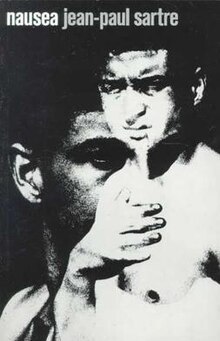
Nausea by Sartre

I once had an old paperback of Sartre’s Nausea and I still remember the cover image of a young man holding his stomach and grimacing—that’s the feeling I get whenever I think of meaningful novels or the danger of fictionalizing my own stories or even changing the names of people in a memoir. I hang on to facts like death clings to life.


Cover of the 1964 English edition of Jean-Paul Sartre's Nausea, 7th printing; New Directions Publishing.

Tuesday, August 5, 2008

Comes a Horseman by Robert Liparulo


Stopped at page 136; the exact line, "I saw you glowing like the Madonna, mi amore!"

I decided to read this book because my daughter is writing a fantasy/thriller and she bought two Liparulo paperbacks to get a feel for the type of book selling right now.

The opening line is, "He waited with his face pressed against the warm metal and his pistol gouging the skin at his lower back." Oh yeah, I love that: sensual, concrete, in media res. The plot ripped along, the mystery beckoned, the writing style seductive, the narration -a swig of dark ale, but a hint of a possible romance between two of the characters threatened the entire experience-like trying to enjoy a ripe peach with a rotten core.

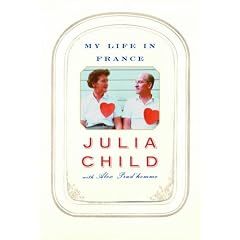
My Life in France by Julia Child


Stopped at page 56. The exact line that stopped me? "I found it all deeply fascinating."

I picked up this book because I had just come back from a month-long trip to France. In addition, I am interested in French Baking. And yet, the minute Julia said, " I found it all deeply fascinating", I thought, "No, it's not."
Julia Child could be excused for this line because it is a biography; she's telling us how she felt. Showing is better than telling but she is a cook not an author so I should cut her some slack, but I can't get past the "deeply fascinating." Maybe if she'd left out the "deeply".